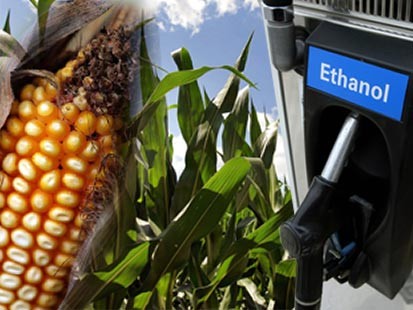
The United States heavily relies on imported oil to fill the tanks of the American vehicles and meet its energy needs. The hope that by reducing the dependence on foreign oil, we can reduce prices in the US, improve the economy and become politically unaffected by oil producing countries, are among major reasons of developing alternative energy sources. Biofuels, and ethanol in particular, is the only renewable fuel that is being produced in significant quantities, which explains public interest to the issues surrounding ethanol production and consumption.
INTRODUCTION Many nations consider bioethanol as a means to increase energy security, an economic stimulus and as a means to combat climate change. Although ethanol will surely remain as a player in American energy future, the rush to implement the renewable energy policies leaves us with overlooked and unresolved problems associated with biofuels. The truth is that corn based ethanol produced in the US within the years of its existence and constant government subsidies have not reversed our dependence on foreign oil, did not significantly reduce the gas prices and environmental benefits of ethanol production (carbon dioxide emission reduction) do not outweigh its negative impacts on ecosystem. Despite the support from the Department of Energy, tax credits and incentives for producing renewable energy, it did not prove its economic sustainability and did not meet the expectations. Therefore, we need to refocus our energy strategies. SUMMARY Environmentalists believe that ethanol, biodiesel and other bio fuels are the viable answer to the global problem of green house gas effect, caused by carbon offset. According to them, it is a completely renewable energy source, since fuel producing crops can be grown all the time. They assert growing crops and building ethanol plants creates jobs and improves the economy. It can reduce the import of the foreign oil and provides energy independence. In a global picture, ethanol supporters state the successful example of Brazil, which significantly reduced its reliance on oil by launching the program of fuel independence in 1970. Currently, Brazilian automobiles consume more ethanol than gasoline and more than 90 percent of the vehicles manufactured in Brazil run on bio fuel. (Regalado, 46). What they fail to recognize is that the successful Brazilian ethanol model is sustainable only in Brazil due to its advanced agri-industrial technology and its enormous amount of arable land available. American climate provides completely different conditions for biofuel growth, and to replace imported oil with ethanol would require covering more than half the land area of the United States in corn or other biomass fields, which will result in shortage of agriculturally suitable lands for growing food crops and will lead to skyrocketing food prices. Due to increased demand on ethanol, during the period of 2007-2008 corn prices went from $3.39 per bushel to $5.14 per bushel, which is equivalent of 34 % increase in corn prices. (Congressional Budget Office). Higher prices for corn increase food prices directly because of the wide variety of food products that contain corn. Higher corn prices can also operate indirectly, through two different mechanisms. First, they increase the price of meat, for which corn is used as an animal feed. Second, higher corn prices raise the price of food by indirectly lifting the prices of other crops—for example, soybeans—if farmers take land that had been planted with those other crops and plant it instead with corn. ETHANOL AND CLIMATE CHANGE Another claim of biofuel supporters is that ethanol reduces carbon dioxide emissions, and therefore helps to combat climate change. According to Michael Wang, researcher from the Argonne National Institute, corn ethanol achieves positive fossil energy balance; and currently it provides the up to 15% reduction in carbon emissions, and with the increased low carbon standard in blending of gasoline with ethanol it has more potential in offsetting the greenhouse gas emissions (Wang, 18). It is true that during the growing cycle crops absorb vast amounts of carbon dioxide from the atmosphere and therefore can reduce global warming. But in reality, with growing amounts of emission into atmosphere, not 15%, but 80% reduction in emission is needed to effectively combat global warming. This demonstrates the inability of biofuels alone to provide this change. Moreover, according to C. Ford Runge “if land is converted from rainforests, peat lands, savannas, or grasslands to produce biofuels, it causes a large net increase in greenhouse gas emissions for decades”. Besides, when ethanol is added to gasoline, the blend burns cleaner than pure gasoline, but it also has “evaporative emissions” from fuel tanks and dispensing equipment in vehicles. These evaporative emissions significantly contribute to ozone layer depletion and create smog. And even blended with ethanol gas burns cleaner, it still produces carbon dioxide.
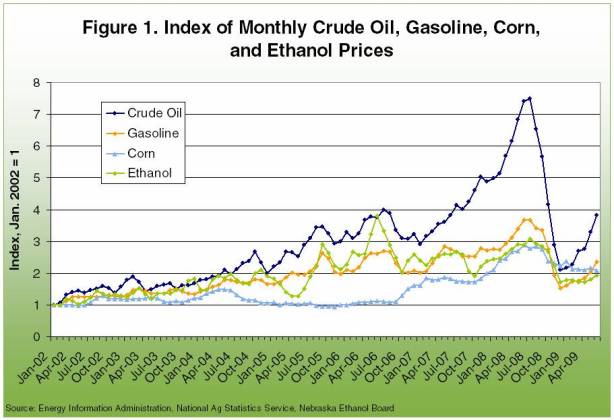
BIOFUELS AND ECONOMY It is the fact - ethanol is a substantial part of American economy that provides people with jobs and means of living. For every billion gallons of ethanol produced, 10,000 - 20,000 jobs are created in all sectors of the economy from production workers, to truck drivers to servers and cooks in rural restaurants (Growth Energy). However, it heavily depends on government subsidies and it has not been tested for its economical sustainability. Main condition for the ethanol industry to be profitable is to have corn prices high enough to allow reasonable margins in the corn ethanol business. The image to the right shows how corn prices are responsive to the crude oil and gasoline increase, as crude oil prices go up, so does corn price. Therefore, for the ethanol industry to be profitable, oil prices have to remain high, and it is dragging America into further exchange for petroleum.
OUR DEPENDENCE ON FOREIGN OIL According to the Department of Energy, Without biofuels the US would have to use 7.2 billion more gallons of gasoline in 2008 in order to maintain same levels of travel (a 5 percent increase). This increased demand for gasoline would drive up the price Americans pay at the pump due to basic supply and demand. Raising fuel-efficiency standards can more effectively reduce gasoline usage than increasing supplies of biofuels. Even if the entire U.S. corn crop were used to make ethanol, it would displace less gasoline usage than raising fuel economy five miles per gallon, readily achievable with existing technologies. Also, fossil fuels provide much of the energy in biofuels production, so biofuels may not replace as much oil as they use. According to Pimentel, Professor of ecology and agriculture at Cornell University, who conducted extensive research and analysis of biofuels, "Ethanol production in the United States does not benefit the nation's energy security, its agriculture, economy or the environment. Since ethanol requires large input of fossil fuels for the production, it therefore is contributing to oil and natural gas imports and US deficits.
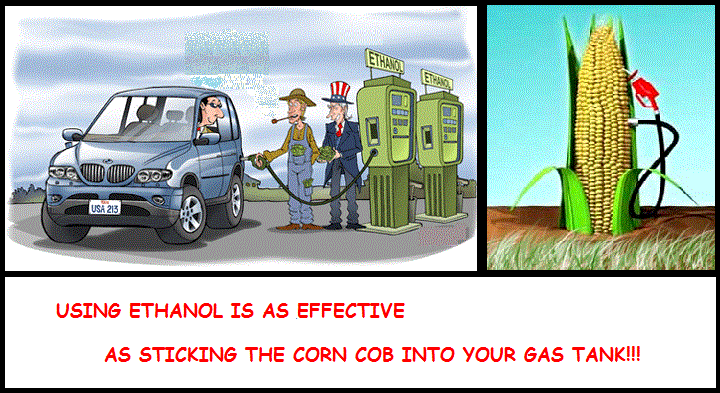
| SUBSIDIZING ETHANOL Supporters of biofuels assert that government stimulus is crucial to ensure the stable growth of the industry and secure the market. Government assistance to ethanol through subsidies, tariffs and legislation requiring a minimum of 10% ethanol to be added to gasoline helps increase the production of ethanol. However, it raises the question about viability of biofuels, and ethanol in particular as an energy source. Provided the tremendous growth in the corn-based ethanol market, it should no longer be considered an infant industry deserving of tax breaks and tariff protection. Currently, federal ethanol tax allowance entitles a company that blends gasoline with ethanol for 51 cents per gallon of gas. Additionally, many states subsidize the corn farmers and ethanol producers. This altogether puts a burden on American taxpayer. Another example of government assistance to the ethanol industry is 54 cents a gallon tariff that the United States impose on imported from Brasil ethanol produced at much lower cost, in order to artificially shield the market for expensive domestic ethanol (Johnson, 27). Use of legislation to secure the production is against free market principals and if this energy source is sustainable, it shouldn’t require government support to successfully position itself in the energy market. When arguing about ethanol, its energy efficiency and environmental benefits, people assume different boundaries. It also takes energy to grow corn, produce ethanol and transport it. Besides, more input needs to be considered: how much soil erosion it creates, what is the amount of pathogens that get adjusted to pesticides used during growth cycle, what are the effects of used fertilizer, how much more pollution ethanol will cause and how much water is required to irrigate corn and produce ethanol by mixing corn with water for further fermenting. And this is not being considered by the government.
FOOD VERSUS FUEL The greatest public concern about growing crops for fuel is that it takes away the agricultural lands which could be used for growing food crops and therefore contributes to food shortage and high food prices. Both biofuels and higher prices for oil raise food prices and they do that synergetically, as oil price goes up it creates more incentive for biofuels, which puts pressure on food prices. Domestic and international consumers of cattle fed with grains face with steadily rising prices. In July 2007, the Organization for Economic Cooperation and Development issued an outlook for 2007-2016, saying that biofuels had introduced global structural shifts in food markets that would raise food costs during the next 10 years. Rising feed prices are also hitting the livestock and poultry industries. Some agricultural economists predict that Iowa's pork producers will be driven out of business as they are forced to compete with ethanol producers for corn.
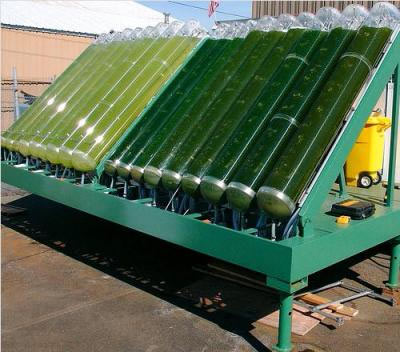
Soaring food prices have devastating effect on poor people, for whom it becomes even harder to afford food. Statistically, to fill the 25-gallon tank of a sport utility vehicle with pure ethanol would require more than 450 pounds of corn, which is enough calories to feed one poor person for a year (Johnson, 28). For example, encouraging farmers in Minnesota to plant more corn and fewer acres of wheat, rise and soy beans, forced food processors with contracts to pay higher prices to farmers to keep them grow food crops such as peas and sweet corn. These growing costs soon enough appeared in the prices of canned and frozen vegetables.PROPOSAL Our lifestyle created an economy that heavily depended on fossil fuels in the past and nowadays corn ethanol is an addition to this list. Meanwhile the existing policies didn’t bring us to the goals that were set for ethanol production. In order to avoid food supply problems it is necessary to adopt an alternative policy model that would eliminate excessive subsidies and tariffs to help the industry. Subsidizing corn should be flexible, meaning when corn prices are going up, we should reduce the amounts of subsidies and vice versa. This will ensure normal economically sound growth of the ethanol industry. Due to current US policies implemented to support ethanol production, other types of potentially effective biofuels are not given a chance. We need to replace existing policies other ones, which would increase the versatility of other energy alternatives and help create market-driven growth in renewable energy demand. (Johnson, 29). Biodiesel produced from algae can be a viable solution to the energy problems. One of the advantages of algae is that it produces more biomass than any other source. It’s energy efficiency is 10 times greater than that of a traditional biomass. Because it produces oil rather than sugar, the oils are fermented to produce alcohol. The oil extracted from algae is being mixed with alcohol (methanole) and lye to produce biodiesel. Produced biodiesel smells much better than regular diesel and its combustion does not result in carcinogenic emissions. Algae can be grown in waste water that does not require treatment for its growth and doesn’t really require fertilizer. Oil produced from algae is very close to the fossil oil which makes it a good source of fuel. Another benefit of biodiesel is that during the process of fermentation, no carbon is being emitted into atmosphere, as opposed to sugar cane and corn based production of biofuels. It can even use carbon dioxide from the oil refineries as a fertilizer for its growth. And most importantly, it doesn’t take away lands from food crops, and therefore doesn’t contribute to the fuel versus food issue. In order to launch the industrial level of algae biodiesel production it is necessary invest into infrastructure and research, just like with any other new development. American navy is currently filling its tanks with biodiesel produced from algae and researchers convinced that algae have great potential in the future energy portfolio of the country. CONCLUSION An increase in energy demand worldwide and in America requires innovation and exploration to find the best alternatives to fossil fuels. Biofuels, as one of the alternative renewable energy sources has its own advantages and disadvantages due to its complex nature and relationship with economy, environment and politics both locally and in the global arena. Ethanol has not dramatically reduced the imports of foreign petroleum over the decades of strong government support. Other options need to be explored. New generation biofuels may have a potential in future energy policy. Another important fact – simple energy conservation will provide with significant results in fuel economy and environment. WORK CITEDTo find the citations of sources and images used in the argument please navigate to this link
|
Return to the Table of Contents
