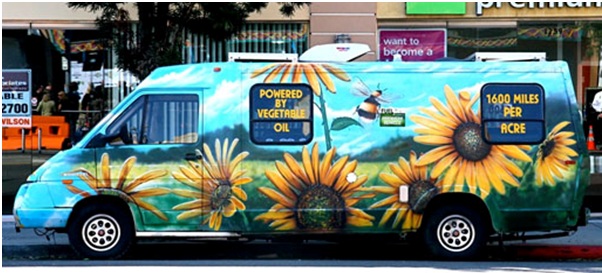
In the “Fuel” documentary released November 14th, 2008 filmmaker and biofuel advocate Josh Tickell unveils the origins of American dependence on fossil fuels and explores possible solutions to resolve the coming energy crisis. Tickell is a professional speaker, author and enthusiast of alternative fuels. His specific experience and focus is on biodiesel, a diesel engine fuel based on vegetable oil and electric vehicles. The film is an independent documentary that eventually details an 11 year long fast paced road trip in Tickell’s sunflower painted “veggie van” being powered by biodiesel from used cooking oil. he takes it around the globe in a hope to find solutions to American oil addiction, “80 percent of which is being imported from politically unstable regions of the world”. (President Bush, “Fuel”).The purpose of the film is to expose the connections between the automakers, oil industries and American foreign politics, help the viewer to build understanding of the issue, promote biofuels and encourage viewers to become more responsible energy consumers. The key features of any successful documentary are the message; the flow- diction and melody presented in effective visual techniques and style of the film; spectacle – the wow factor, fresh convincing information, and realism, presented in a strong and accurate evidence enhancing the meaning of the film.
The film starts with a joyful relaxing story of the main hero, Joshua Tickell, a son of an Australian surfer and Cajun French mother growing up in a harmony with the beautiful and rich wildlife of Australia. Soon enough the scene is shifting to a black and white gloomy pictures of the the Bayou’s in Louisiana, where people cannot swim or fish anymore because of the polluted toxic water. That’s what Josh finds upon his arrival with the family to America. This is all caused by the oil industry and inability of the EPA to enforce regulations due to the fact that they were sponsored 90% by oil companies. In his documentary, he reveals the shocking facts of environmental data being fabricated by the agency. The story of his childhood used as an introduction contextrualized why he is looking for a viable replacement to the oil that can help reduce harm on the environment and prevent energy wars. In Germany during his study of environment he learns about biodiesel, the new knowledge ignites him. And here he is, going across the United States in his bio-diesel eco-van enthusiastically campaigning for more sustainable, environmentally friendly fuels. His van, equipped with its own oil-cleaning system, was filled along the way with waste oil from fast food restaurants. During his journey he interviews people who are subject matter experts from all over the spectrum of fuel use. We meet with the oil company executives, who acknowledge that oil is getting scarce and harder to drill for. Next we see environmentalists, educators and policymakers who are devastated by water contamination with heavy metals like lead and mercury, growing foreign debt and weakening economy. And finally we are being pointed onto our love to big vehicles through the scene, where average Midwestern families buy huge vehicles because they are being promoted by automotive companies and reflect the idea of American lifestyle, where everything is generously big and abundant.
The energetic hopeful mood of the author’s trip is being interrupted by his devastation, when all his hard work, years of presentations and school visits expected to lead to an effective start of the bio-fuels in America, were destroyed. Destroyed by the Science magazine publications against biofuels, where they criticized biofuels of being harmful for environment and causing food crisis. Tickell doesn’t give up and offers a solution consisting of five building blocks of sustainable future energy portfolio: sustainable biofuels (i.e. biodiesel from algae), wind power, solar power, fuel efficient hybrid vehicles and rethinking public transportation. As a final note Joshua Tickell states that the cheapest way to improve energy efficiency is simple energy conservation and adopting new mentality aimed to save and conserve, which he features in his later publications. (Tickell, 57) Directed by Josh Tickell and produced by Josh Tickell Productions, Blue Water Entertainment, Open Pictures, Intention Media, “Fuel” is entertaining and engaging. The film is easy to follow and can be understood by a wide range of the public, beginning with children from middle school and ending with highly educated people. Great “veggie-van” soundtrack sets the mood and beautiful music effectively encompasses the scenes and helps the viewer shift from one episode to another by offering an aid in catching up with emotional changes. “Fuel” is effectively animated by powerful graphics, it provides with extensive analysis of different types of biofuels, fairly addressing pros and cons of each type; the information presented in the film is relevant to the issue. Each part of the documentary is assigned its own heading, which makes it well organized and also gives the viewers a break to catch their breathbetween parts and not to get lost in loads of information. He delivers a powerful message and offers a solution by presentsing in one of the scenes a promising statistics on bio-diesel potential (Tickell, 87)
|
The scenes covering the events of September 11th and Hurricane Katrina enhanced the film visually and thematically. By presenting the videos and email conversations from the congress members Tickell established a context for the provocative point of view on ecologically indifferent and “oil hungry” Bush’s administration. The script writer John O’Hara effectively combined the history lesson of the automakers industry with the petroleum industry development and provided a new angle to view the familiar issue of dependence on foreign oil. The script won the Writers Guild of America Award. The documentary employs a great sense of humor; in the beginning it has an amusing scene at the fast food restaurant that hooks the audience, where a puzzled employee is not sure how to answer the question if Josh could have their used frying oil. The tone of the documentary is far from trying to scare people with the doomed world poisoned by addiction to oil; it is rather full of hope, positive emotion and belief in human ability to change the current situation for good. Another strength in appealing to the audience is effective usage of interviews with so called “green” celebrities, such as Julia Roberts, Woody Harrelson, Sheryl Crow and others, who share their concerns about the environment and methods they use in their daily life to reduce pressure on environment. As opposed to common informative feature of a regular documentary covering an issue or an event, this film is rather promotional, as it incorporates a persuasive message for the viewer: change your lifestyle, don’t ignore the situation and embrace biofuels. Despite its strong features, the “Fuel” leaves a feeling of missing the heart of the issue and untouched subject of global warming. It leaves us with a strong unstated argument for using bio-diesel. According to Tickell’s interview with “Popular Mechanics” he intentionally stayed out of the global warming dispute. Instead he focused on money and economical aspects without using a global warming argument because he believes that major change for the green revolution has to happen at a business level. Businesses generally don’t care about what happens in the world: “…at the end of the day, it’s an efficiency equation”, says Tickell. (Popular Mechanics, par. 5). However, I believe the global warming is the most important problem with environment and should have been addressed there. “Fuel” sheds light on various global issues like environmental sustainability and maternal health through its thorough analysis of the environmental and health problems as a consequence of increased oil production. In one of the scenes, he presents a statistics of increased cancer cases, miscarriages and fertility problems in the regions of Louisiana where oil companies burn the production waste and dump it into local waters. This film makes a disturbingly shocking connection between issues of terrorism and war and American economy being dependent on foreign oil. The presented evidence, like videos from the Congress and disclosed politicians' e-mail records, is enlightening. It shows the audience the problem in a completely new light, raising the curtain and revealing the American imperial mindset that put oil before the values and equal rights. The documentary overall meets the criteria by providing an interesting plot. It effectively connects historic events and scientific data. The author delivers the message about biofuels by integrating it to his story of travel around the world in a search of solution to energy crisis and promoting biodiesel. What can be better evidence of the “Fuel”s great quality than the fact that it won the Sundance Audience Award in 2008? I wanted the ranking system that would span from the greatest documentaries ever to the worst imaginable, the system that would fairly rank film to where it belongs. · Five Stars – Among the best of all time. A great film. · Four 1/2 Stars – One of the best of the year. A must-see. · Four Stars – Isn’t perfect, but very strong. Highly recommended. · Three 1/2 Stars – Worth seeing, recommended. · Three Stars – A respectable effort. Enjoyable. · Two 1/2 Stars – Not good, not awful. But not worth your time. · Two Stars – Bad. The elements don’t work. · One 1/2 Stars – Annoyingly bad. You’ll suffer through the film’s runtime. · One star – Painfully bad. Everything is poorly done. · Half Star – Small children with no film experience could do better if given the chance. A half star film will ruin your day, and should be avoided at all costs. I gave it 4.5 stars out of a possible 5. Although this was the best documentary of 2008, it is not in the same category of the greatest documentaries of all time, like “Hoop Dreams” or “Supersize me” which are forever recorded in the history of cinematography. However, it is a really great film and definitely deserves spending two hours on watching it, may be because these two hours can change the understanding of the energy problem and other issues stemming from it. |
|
WORK CITED To find the citations of sources and images used in this paper please navigate to this link Return to the Table of Contents |
||